
Overview
Two emergency room visits. Same arrival time. Similar total length of stay. Completely different experiences.
This case study examines why the perceived quality of care diverged sharply – not because of clinical outcomes, but because of process design.
From a Lean Six Sigma perspective, the contrast highlights how flow, handoffs, and queue design directly shape patient experience, even when headline metrics appear comparable.
Context
I conducted a study on the emergency room visits for two different hospitals. On paper, both visits showed roughly the same total time spent in the ER. In practice, one felt efficient and controlled, while the other felt exhausting and disorganized.
The difference was not what care was delivered.
The difference was how the care process was structured.
Process Comparison
Below is a timeline comparison for both hospitals.
Note that for Hospital B no imaging were done, as that would have added considerably more time to the process.
Check In
Wait
Vitals and early diagnostics
Wait
Physician assessment
Wait
Imaging
Wait
Treatment
Discharge
The patient moved forward continuously, with minimal waiting and few hand-offs. Each step logically built on the previous one.
Check In
Wait
Vitals
Wait
Triage
Wait
Registration
Wait
Entry into ER
Wait
Doctor assessment (no imaging)
Wait
Diagnosis
Discharge
Although the total visit duration appeared similar on paper, the experience was dominated by repeated waiting, uncertainty, restarts or redundant steps.
What the Data Showed
- Average daily ER patients: 111
- Average time from triage to physician: ~1 hour 30 minutes
- Average total ER time: ~3 hours 30 minutes
From a Lean Six Sigma perspective, these metrics alone do not explain dissatisfaction. The underlying issue lies in how that time is distributed.
Bottlenecks
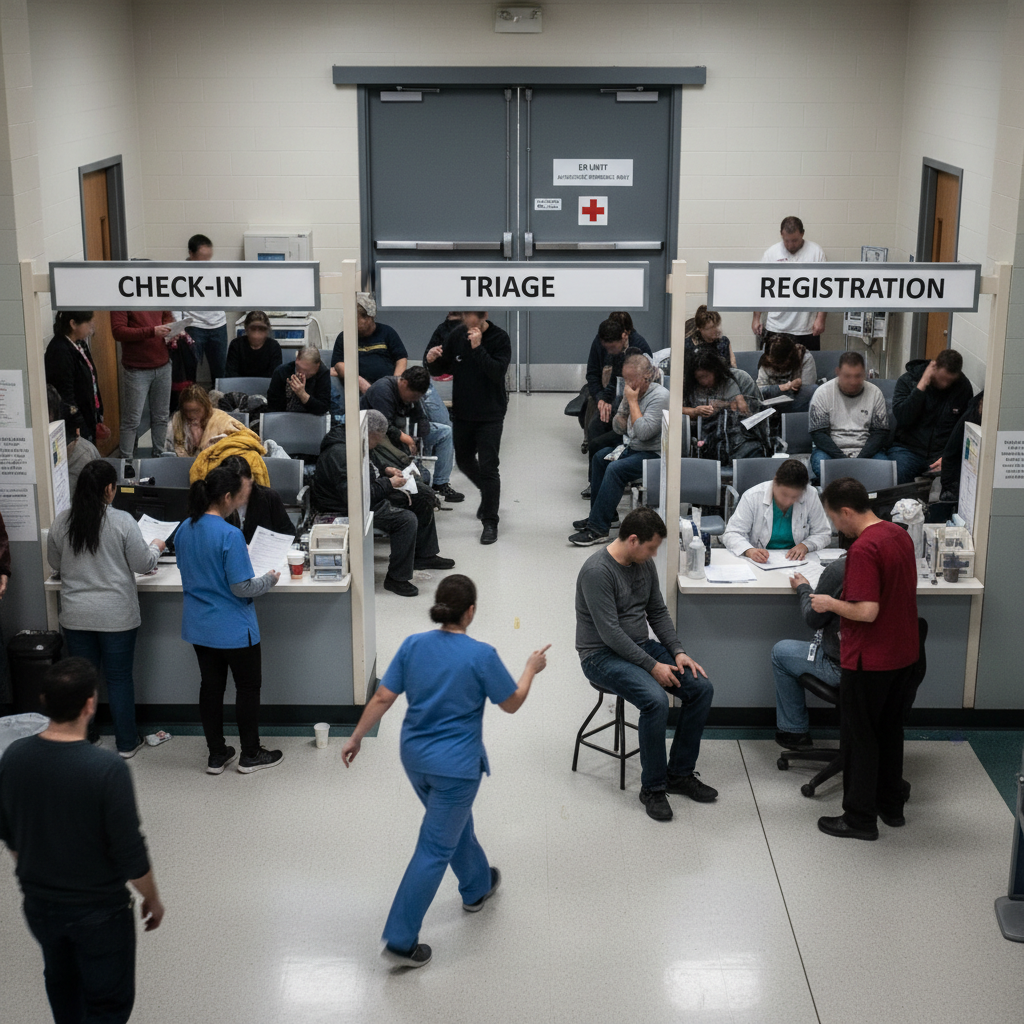
The primary constraints occurred at the front end of the process:
- Vitals
- Triage
- Registration
These steps operated as separate queues rather than an integrated intake system, creating congestion and delays early in the patient journey.
Root Causes
Analysis identified several contributors to inefficiency:
- Staffing shortages during peak arrival times
- Poorly sequenced intake processes
- Redundant data collection steps
- No fast-track pathway for low-acuity patients
- Delays incorrectly attributed to a “small ER unit,” rather than to process design flaws
Notably, physical capacity was treated as the limiting factor, when flow design was the true constraint.
Proposed Improvements
Based on established Lean Six Sigma healthcare practices, two targeted changes were identified:
- Unified Front-End Intake
- Combine vitals, triage, and registration into a single intake interaction
- Reduce handoffs, duplicate questions, and queue switching
- Fast-Track Pathway for Low-Acuity Patients
- Separate low-complexity cases from the main ER flow
- Protect physician capacity for higher-acuity patients
These changes focus on redesigning flow rather than adding space or headcount.
Estimated Expected Results
Based on comparable Lean Six Sigma healthcare implementations:
Staff impact:
Reduced intake congestion and cognitive load, improving consistency without additional staffing
Door-to-provider time:
30–40% reduction
(~1h 30m → ~50 minutes)
Total ER time:
20–30% reduction
(~3h 30m → ~2h 30m)
Patient satisfaction:
Expected increase of 20–30% due to fewer waits and clearer progression
Key Takeaway
Patient experience is driven by flow, not just total time.
Multiple short waits feel longer – and more frustrating – than one continuous, well-designed process, even when the clock shows no difference. This case illustrates how disciplined process improvement can outperform physical expansion, and why data-driven analysis should replace assumptions when diagnosing performance problems.