

I designed and built a humanoid-style robot entirely from scratch as a Mechatronics Engineering project with a group of friends. Components were custom developed – no commercial robot platforms were used.

Project Goal
The goal was to design and integrate a robotic system capable of mobile navigation, articulated arm manipulation, and basic human-like interaction through motion and visual feedback.
Future plans were to integrate a Brain-Computer Interface (BCI) into the robot to allow operators to control the robot via thoughts – story for a separate post!
Mechanical Design
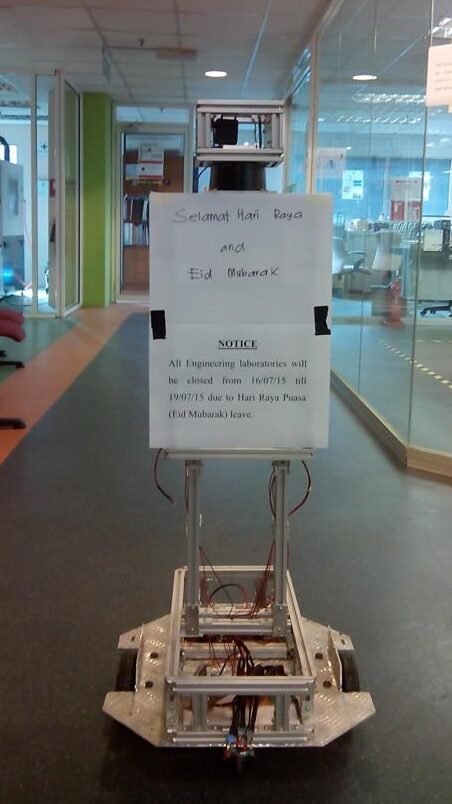
The robot features an upper-body humanoid form mounted on a mobile base:
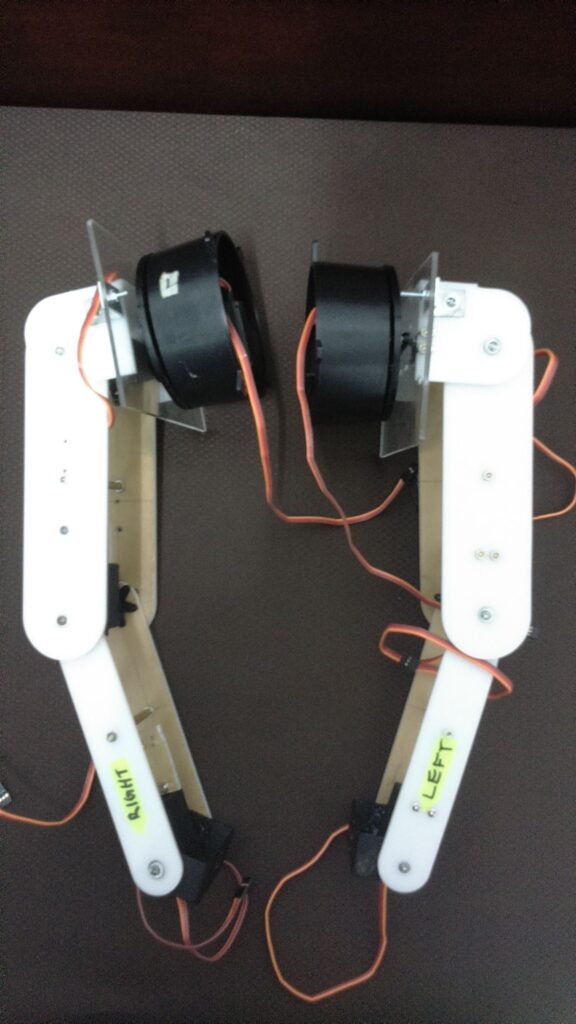
The chassis and arm structures were designed in CAD using SolidWorks and fabricated using a combination of aluminum and 3D-printed components. The modular design allowed easy access to joints and electronics for maintenance and upgrades.
Actuation and Motion Control
Each joint is driven by high-torque servo motors selected based on torque and precision requirements. I implemented:
This approach enabled smooth arm trajectories and controlled base movement.
Electronics and Control
The control system uses a Raspberry Pi and Arduino in a master–slave configuration:
The separation improved timing reliability for servos while allowing more complex processing on the Pi.
Sensors and Interface
The LCD face provides a simple, human-like interaction layer.
Software
I developed the software in Python (Raspberry Pi) and C++ (Arduino). The architecture separates high-level decision-making from low-level control, with serial communication used between controllers. Safety limits were implemented to protect joints and actuators.
Results
The robot navigates using its wheeled base, executes precise 6-DOF arm movements with both arms, and displays visual feedback through the LCD face.
A new Engineering Lab Assistant was hence born – ELA…