
Click here to read about the design of the robot.
THE PROBLEM: Balancing Structural Integrity with Payload Requirements
In high-stakes Mechatronics and Medical Device development, physical failure during operation is a catastrophic risk to both the hardware and the end-user. For the ELA Humanoid Assistant, the challenge was to ensure the 14-DOF (Degree of Freedom) frame remained lightweight for battery efficiency while maintaining a high Factor of Safety (FoS) under dynamic loads. We needed to validate the chassis’ response to inertial forces during navigation and high-torque maneuvers before committing to the fabrication phase.
THE SOLUTION: Finite Element Analysis (FEA) & Iterative Design Refinement
As the Senior Technical Lead, I implemented a “Shift-Left” engineering strategy by performing a comprehensive Structural Static Study in SOLIDWORKS Simulation. This virtual validation process ensured the 20x20mm aluminum architecture was optimized for real-world stress:
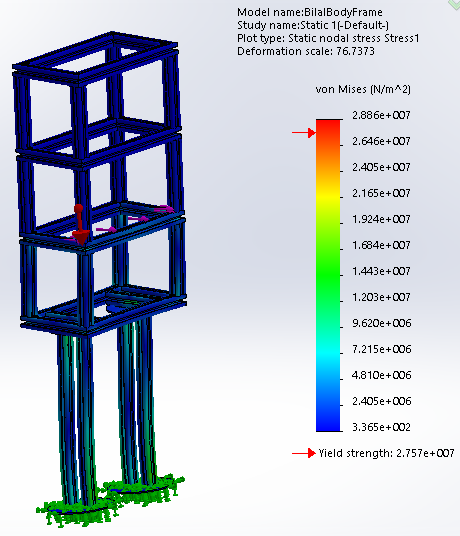
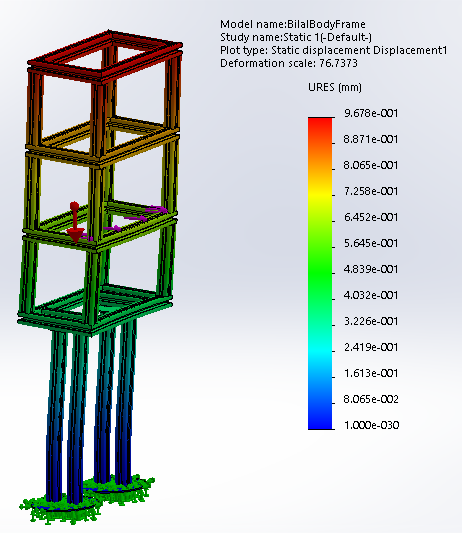
Defining Boundary Conditions:
I established fixed-geometry fixtures at the mobile base interface to simulate the rigid wheeled-navigation mounting points.
Dynamic Load Scenario Modeling:
I executed multi-scenario load cases to simulate the physics of movement:
- Longitudinal Inertia: Forces generated during rapid forward/reverse acceleration.
- Vertical Compression: Gravity and payload distribution when the robot is fully loaded.
- Lateral Torque: Torsional stress exerted on the frame during high-speed rotational turns.
Mesh Sensitivity & Optimization:
To ensure the accuracy of the Von Mises stress results, I refined the mesh in high-concentration areas – specifically at motor mounts and modular joints – while maintaining computational efficiency.
THE IMPACT: 40% Reduction in Physical Prototyping Cycles
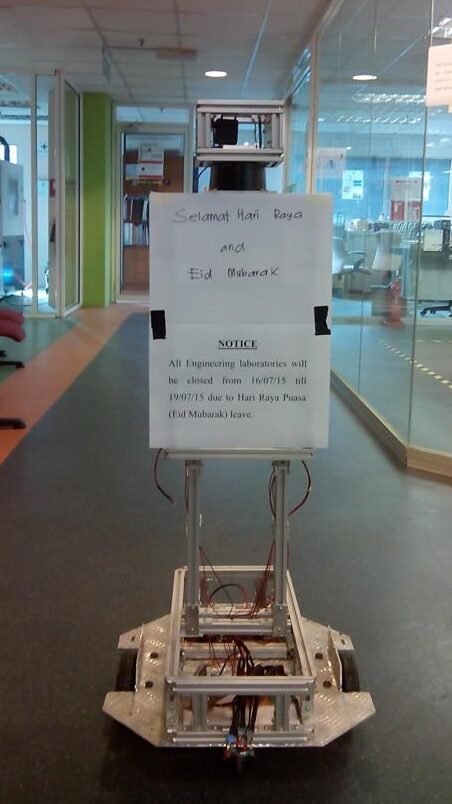
By identifying potential failure points in a virtual environment, I was able to optimize joint reinforcement and wall thickness before a single aluminum member was cut.
Design Verification:
Validated that all operational stresses remained well below the yield strength of the Aluminum 6061-T6 frame, achieving a Factor of Safety (FoS) of 2.0+.
Failure Prevention:
Identified a stress concentration at the lower lumbar joint, leading to a design iteration that avoided a potential field failure.
Regulatory Alignment:
This workflow serves as the Design Verification cornerstone for ISO 13485 and FDA 510(k) compliance, ensuring that every engineering decision is backed by verifiable data.